
December–January Is a Scam: Thoughts on Holidays, Consumerism, and Optics
It's a Scam
<3
It's a Scam <3
December to January is a black hole. Time doesn’t exist. Routines dissolve. Everyone pretends to feel something very specific about it.
Also known as: Holiday Szn.
People usually fall into one of three camps:
Genuinely joyful
Begrudgingly participating
Publicly commiserating
I exist now somewhere in the overlap of all three. Heavily skewed toward commiserating.
I don’t want to be a jaded grinch at 29, but realism, adulthood, bills, taxes, and working in Marketing will rot the magic out of anything eventually. “The Holidays” have been stripped down, optimized, monetized, and resold back to us as a lifestyle. A commercial monster wearing a cozy sweater.
Before the Jading
Middle School and the Myth of a Magical Christmas
I fully bought into the idea of a “magical Christmas”.
In my head, this looked like a massive family dinner of 20 people. A juicy roast turkey (which I don’t even like). A seven-foot pink Christmas tree in a mansion with a fireplace. Lavish gifts. Matching pajamas. Snow outside the window. Hot cocoa by the fire.
None of these things existed in my real life.
This fantasy came from Western, Canadian Christmas culture. The kind that’s marketed as wholesome, traditional, family-centric. I felt pressure to perform it. To look like my peers. 7AM wakeups. Cookies by the fireplace. Milk for Santa.
In South Korea, the pressure to appear perfect still exists, but the holiday itself carries less symbolic weight. Over time, Christmas has become less secular, which strips it of moral obligation. It’s not about tradition or legacy. It’s about presentation. Social rituals. Aesthetic moments. Winter dates, cafes, curated dinners, shopping.
It’s still polished. Still HELLA performative. But it’s not asking you to feel anything profound. There’s no expectation that this day should heal your family, redeem your year, or make you grateful for your life. Unless you grow up in a Christian household, of course ;).
Because it’s less symbolic, it’s lighter-ish by comparison, I think. Less emotionally loaded in some ways. Less punishing if you opt out.
Western Christmas, especially in Canada, seems to be a lot heavier with symbolism. Again, personal opinion. But it’s moral. Familial. Emotional. It’s sold as sacred time. A performance of togetherness, generosity, warmth. If it doesn’t look or feel right, you’ve somehow failed at being human. Western Christmas also comes with a very specific visual language. One that’s been normalized to the point of invisibility. A white, elderly man with a beard. A red suit. A chimney. A nuclear family. A suburban home.
And at some point, you start asking the obvious question. Why is Santa Claus a white man?…

DYK? Santa in Korea = Haraboji (translating to, ‘grandfather’), who’s usually dressed in green! Why is the embodiment of generosity, magic, and moral reward filtered through whiteness? Why does “goodness” show up looking like a retired Coca-Cola mascot? Why was I, a Korean kid in Toronto, expected to suspend disbelief for a figure that reflected none of my reality?
It’s subtle, but it sticks. Another reminder that even the most “universal” traditions are culturally narrow, exported, and sold as default.
Becoming Jaded Early
The Reality of The Holidays For Young Me
The reality was my parents worked nonstop. Both small business owners in Toronto. There wasn’t time to sit down and romanticize a holiday, especially one centered around an imaginary man in a red suit. Almost all of my extended family lived in South Korea, and still does.
So Christmas was small. Nuclear. Practical. A meal. A few modest gifts. Just enough to keep us from becoming fully cynical children.
How I Found Out Santa Wasn’t Real
My dad responded to my letter to Santa on a yellow early-2000s Wendy’s napkin. In his very recognizable handwriting. Explaining that a dog “wasn’t possible this year”.
Devastating.
I put two and two together. Santa was my dad. We stopped doing gift exchanges sometime in middle school.
High School - Uni Era
Honestly? A blur. Christmas wasn’t really a thing. New Year’s meant Korean church. I was happy to have a break from school.
Post-Grad Reality Check
Then I entered the workforce.
My strongest holiday memories involve working. Especially in B2C digital advertising. Boxing Day and New Year’s weren’t about rest or reflection. They were about performance. Revenue. Conversion rates. Selling $1,000 vacuums to emotionally vulnerable people.
That’s when it fully clicked.
People suuuuure do love using the holidays as an excuse to consume. Myself included!

Practicality set in
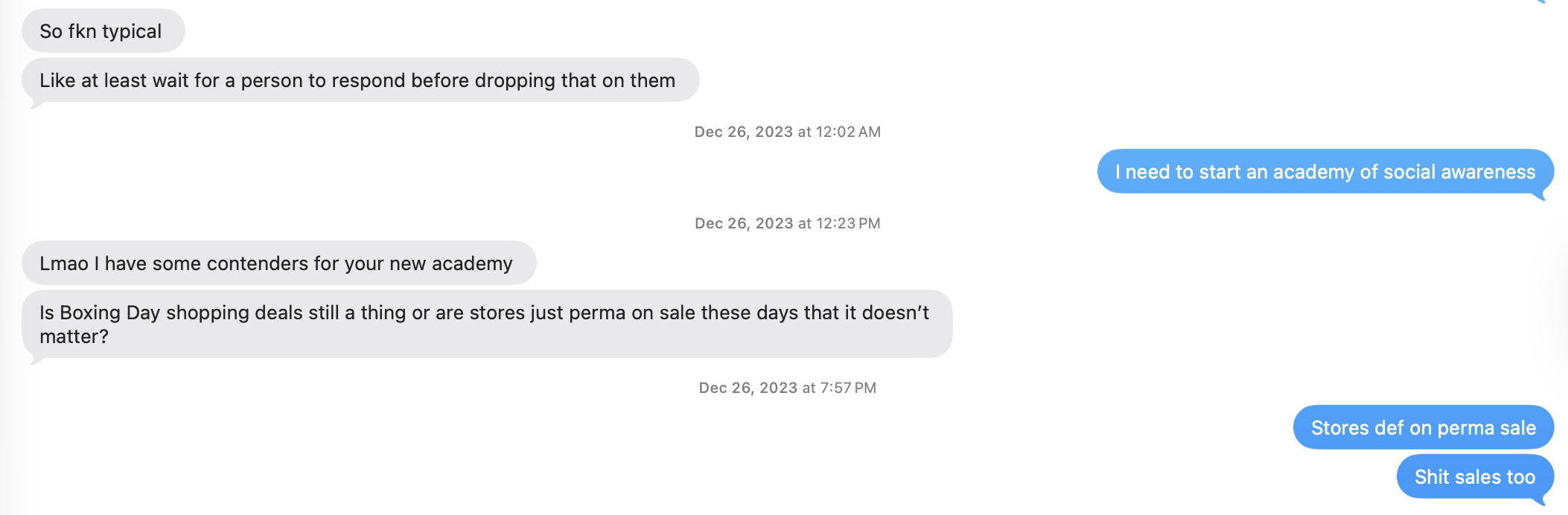
Stores started offering shit sales anyways
Now, 2025
I want to unsubscribe.
The holidays feel oddly quiet and deeply overstimulating at the same time. Too slow. Too loaded. Emotions spike. Loneliness gets louder. Grief resurfaces. Family dynamics get tense. If you don’t have a stable family, or any family at all, this time of year can feel especially brutal.
I spent this holiday season buying gifts for myself. Because I deserved them. I also picked up small trinkets and memorabilia items for friends. Yes, I participated in consumerism. I love Sephora. I’m not above it. But I also thrifted heavily and supported local Toronto shops.
Balance, I guess?
Summary of Thoughts
Let’s PLEASE stop pretending there’s one right way to do the holidays.
If you have a warm bed, a home, and people you love to spend this time with, that’s a privilege. A real one.
If the holidays are genuinely joyful for you, great. Just be aware that for many people, they’re complicated at best and painful at worst.
Spend the holidays how you actually want to.
Alone. With friends. With chosen family. With nobody at all.
Open gifts in solitude.
Read a book.
Listen to Justin Bieber - Mistletoe (all time classic).
Do whatever the fuck brings you joy.
x Frances